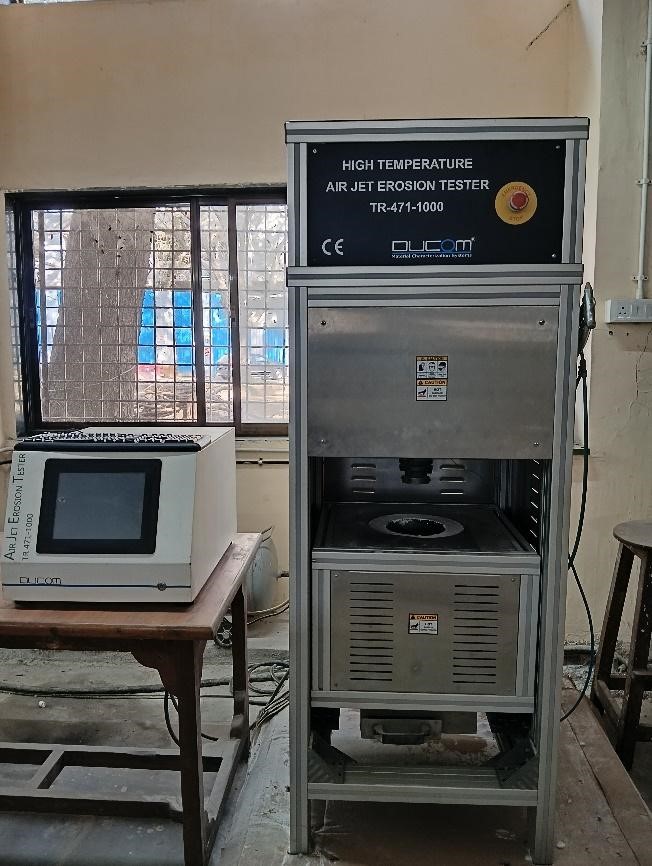

Air Jet Erosion Tester
A High Temperature Air Jet Erosion Tester (such as Ducom’s Air Jet Erosion Tester, often referenced in similar models like TR-471 series) is a laboratory instrument used to evaluate erosion resistance of materials and coatings by impacting them with a jet of high-speed abrasive particles carried in air — even at elevated temperatures (ambient up to ~1000 °C). It simulates real-world wear from particle impingement such as in turbines, boilers, aerospace parts, and pneumatic systems.
Typical Specifications (Ducom Air Jet Erosion Tester/TR-471-1000-type)
Note: There isn’t a publicly available full datasheet specifically titled “TR-471-1000” online, but the Ducom Air Jet Erosion Tester specifications apply and are representative of the high-temp version.
Key Features
High-Temperature Capability
- Integrated furnace for testing at temperatures up to ~1000 °C, allowing evaluation of high-temperature materials/coatings under more realistic thermal conditions.
Adjustable Impact Conditions
- Variable particle velocity, feed rate, impingement angle, and temperature to simulate different service or environmental conditions
- Enclosed System with Safety Controls
- Dust-prevention chamber and air filtration system to capture particles and minimize laboratory contamination.
- Data & Automation Ready
- Modern units may include software control and reporting features (e.g., digital assistants like MOOHA) for data logging and integration with lab systems.
How It Works
- Preparation: A test specimen (metal/ceramic/coating) is mounted inside the test chamber.
- Heating: The furnace brings the sample and air stream to the desired temperature (up to ~1000 °C).
- Erosion: A controlled jet of air carrying abrasive particles (alumina/silica) impacts the surface at a chosen velocity and angle.
- Measurement: Material loss (usually by weight change) and erosion patterns are measured to assess resistance. Comparison across materials/coatings gives ranking of performance.
Applications
- Erosion mechanism of gas turbine blades in a power plant.
- Ranking of wear resistant coatings for edges of turbine blades and helicopter blades.
- Wear resistant boiler tubes exposed to fly ash in coal fired power plants.
- Erosion resistant coatings in pipes and bends used in pneumatic conveyors.
- Erosion protective paints used in the transportation industry