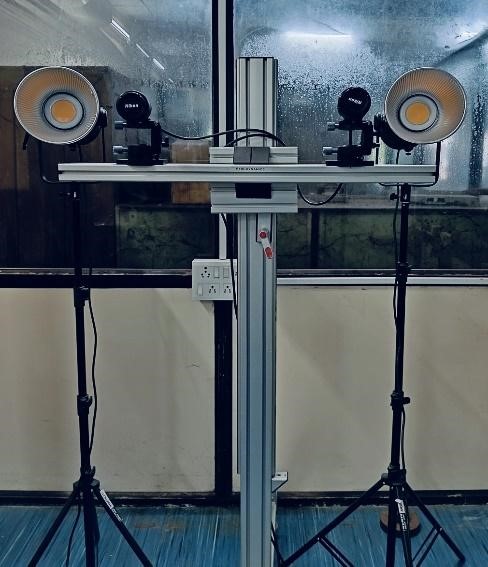

PYRODYNAMICS DIC (DIGITAL IMAGE CORRELATION)
Digital Image Correlation is a non-contact optical measurement technique that tracks the motion and deformation of a specimen’s surface by comparing digital images taken before and during deformation.
Principle of Operation
- The surface of the specimen is prepared with a random speckle pattern so that each small area (subset) can be uniquely identified in images.
- A series of images are captured during a mechanical test using one or more cameras.
- Specialized software uses correlation algorithms to track how each subset moves between the undeformed (reference) and deformed images.
- From this tracking, displacement fields are obtained. Spatial derivatives of displacement are used to compute strain fields, usually given as full-field maps over the specimen surface.
Key Features
- Non-contact: No physical sensors on the specimen — reduces influence on material behaviour.
- Full-field data: Provides displacement and strain distribution over the entire visible surface rather than at discrete points.
- 2D or 3D Measurement: Using a single camera for in-plane 2D or multiple cameras for full 3D surface mapping
Typical Applications
- Mechanical tests (tensile, compression, bending) to characterize material properties
- Fracture and crack propagation studies.
- Structural deformation analysis in laboratory and field conditions.