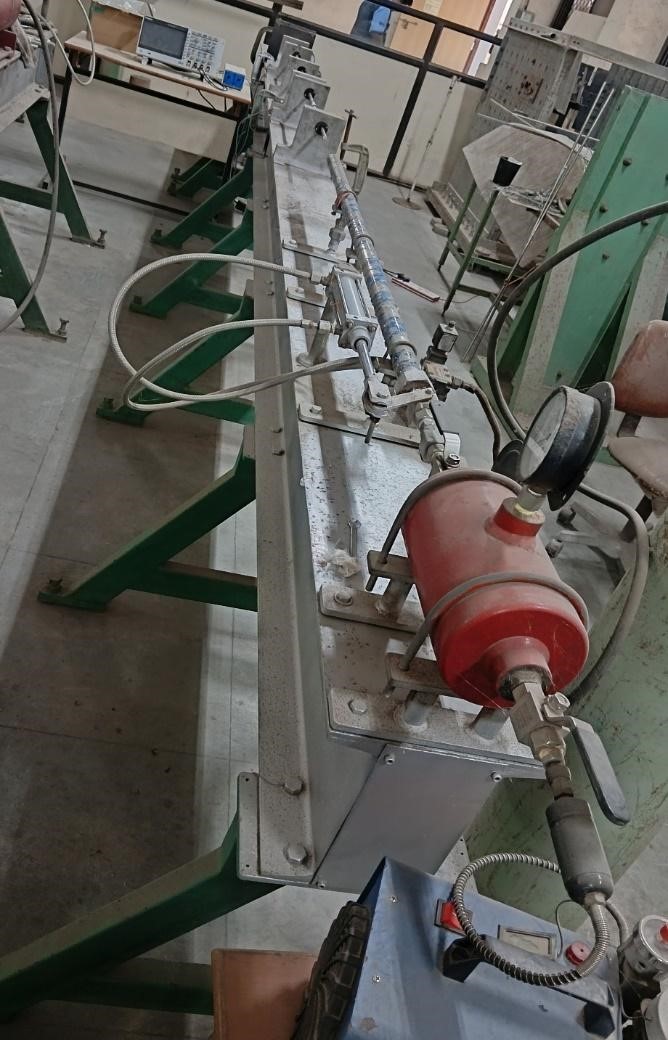

SHPB Test (Split Hopkinson Pressure Bar)
Purpose
- Used to determine dynamic mechanical properties of materials at high strain rates (≈10²–10⁴ s⁻¹).
- Common for metals, polymers, ceramics, composites, rocks, and concrete.
Principle
- A short specimen is sandwiched between two long elastic bars.
- A stress wave generated by an impact travels through the bars.
- From incident, reflected, and transmitted waves, stress–strain–strain rate of the specimen are calculated using 1D wave theory.
Main Components
- Striker bar – impacts the incident bar to generate stress waves
- Incident bar – carries incident and reflected waves
- Transmission bar – carries transmitted wave
- Specimen – placed between incident and transmission bars
- Strain gauges – mounted on bars to record waves
- Data acquisition system – high-speed recording
- Gas gun / launcher – accelerates striker bar
Measured Outputs
- Dynamic stress–strain curve
- Strain rate
- Dynamic modulus
- Yield strength, flow stress, failure behavior
- Key Assumptions
- One-dimensional elastic wave propagation in bars
- Uniform stress and strain in specimen
- Frictionless interfaces (often lubricated)
Applications
- Measures material behaviour at high strain rates (impact/rapid loading).
- Used for dynamic stress–strain characterization of metals, polymers, composites, ceramics, rocks, and concrete.
- Applied in automotive crash, aerospace impact, and defence/ballistics studies.
- Helps evaluate impact, blast, and shock resistance of materials.
- Provides data for material modelling and simulation validation.
- Used in civil and mining engineering for dynamic behaviour of rocks and concrete